

How Do Mechanical Watches Work? A Beginner’s Guide to Mechanical Watches
Mechanical watches have a character of their own. Unlike quartz watches, which rely on a battery and electronic circuit, a mechanical watch is powered by a series of springs, gears and finely tuned moving parts working together in sequence.
For many people, that is part of the appeal. A mechanical watch does not simply tell the time. It reflects a more traditional way of making things, where the movement inside the case is a piece of engineering in its own right.
If you are considering your first mechanical watch, this guide explains how they work, the difference between automatic and manual movements, and why they continue to appeal in a world full of smart devices and battery-powered alternatives.
What is a mechanical watch?
A mechanical watch is a watch powered by a wound spring rather than a battery. That spring, known as the mainspring, stores energy and releases it gradually through the movement. As that energy passes through the gears and regulating components, it drives the hands around the dial.
In simple terms, a mechanical watch works by storing energy mechanically and releasing it in a controlled way.
There are two main types of mechanical watch:
- Manual mechanical watches, which need to be wound by hand.
- Automatic mechanical watches, which wind themselves through the motion of the wearer’s wrist.
Both operate on the same basic principles. The main difference is how the mainspring is wound.
Do mechanical watches need a battery?
No. A mechanical watch does not need a battery.
That is one of the main differences between mechanical and quartz watches. A quartz watch uses a battery to send power through an electronic movement. A mechanical watch uses stored spring tension instead.
This is often one of the first questions people ask when buying their first automatic watch, and understandably so. If you are used to quartz watches, it is natural to assume all watches are battery powered. Mechanical watches are different. They rely on traditional watchmaking principles, using moving parts rather than electronics to keep time.
How does a mechanical watch work?
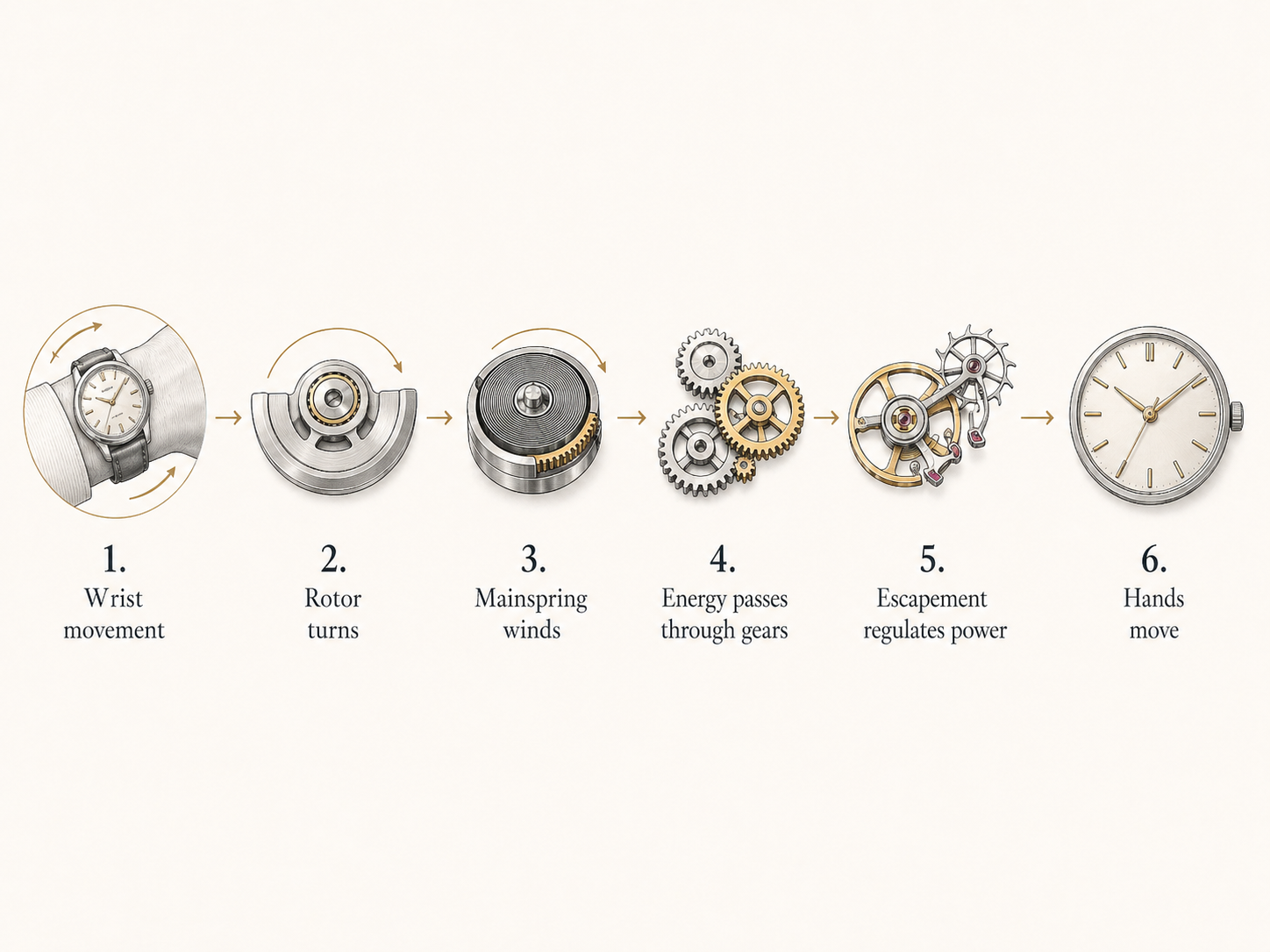
A mechanical watch works by storing energy in a wound spring, then releasing that energy in a controlled way through a series of gears and regulating parts.
Although the movement inside a mechanical watch can look complex, the basic idea is fairly straightforward. Energy is stored, transferred, controlled, and finally displayed as time on the dial.
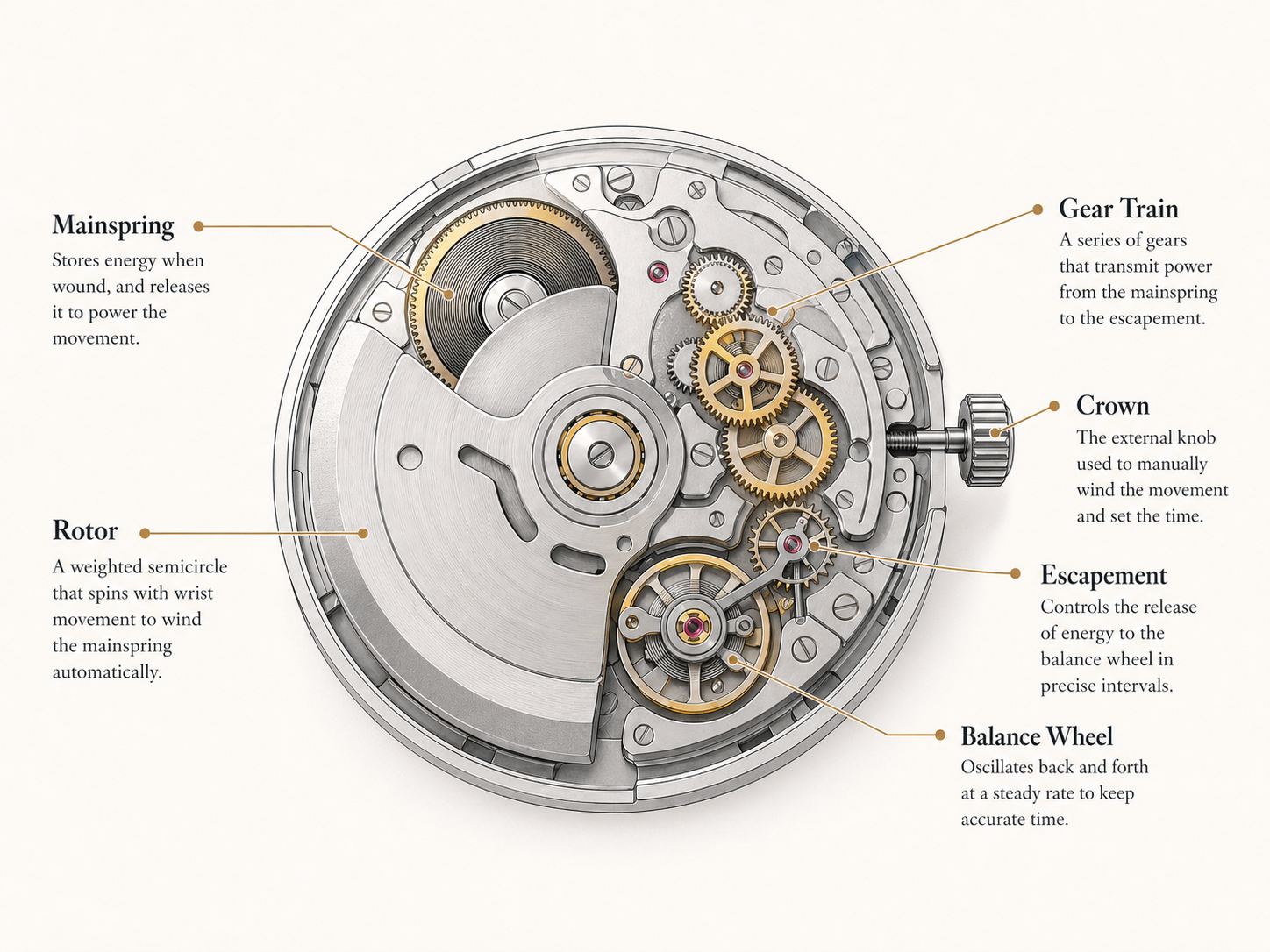
The mainspring stores the power
At the heart of a mechanical watch is the mainspring. This is a tightly coiled strip of metal housed inside a small drum called the barrel.
When the watch is wound, either by hand or by the movement of an automatic rotor, the mainspring tightens. As it slowly unwinds, it releases energy into the movement.
This stored energy is what powers the watch.
The gears transfer the energy
The energy from the mainspring passes through a connected series of gears, often called the gear train. These gears control how power moves through the watch and help convert the release of energy into measured movement.
This gear system eventually drives the hands on the dial, allowing the watch to show hours, minutes and seconds.
The escapement controls the release of power
If the mainspring simply released all its energy at once, the watch would run down almost instantly. The escapement prevents that from happening.
The escapement releases energy in tiny, controlled steps. This is part of what gives a mechanical watch its distinctive ticking motion.
In many mechanical watches, the seconds hand appears to sweep smoothly around the dial. In reality, it is moving in several small steps per second. That is why the motion looks much smoother than the once-per-second tick often seen on quartz watches.
The balance wheel regulates timekeeping
The balance wheel works with the escapement to regulate the watch. It moves back and forth at a steady rate, helping control how quickly the stored energy is released.
You can think of it as the timekeeping heart of the watch. Its regular motion is what allows the watch to measure time consistently.
The hands display the time
Finally, the regulated movement of the gears is transferred to the hands. The hour, minute and seconds hands move across the dial, showing the time in the familiar way.
What is the difference between automatic and manual mechanical watches?
Both automatic and manual watches are mechanical. They use a mainspring, gears, an escapement and a balance wheel. Neither needs a battery.
The difference is how they are wound.
Manual mechanical watches
A manual mechanical watch is wound by turning the crown by hand. This tightens the mainspring and gives the watch the energy it needs to run.
Depending on the movement, a fully wound manual watch may run for a day or two before it needs winding again. Some have longer power reserves, but the basic habit remains the same: wind the watch, wear it, then wind it again when needed.
For some people, this is part of the charm. Winding the watch becomes a small daily ritual. It also gives a direct sense of connection with the mechanism inside.
Automatic mechanical watches
An automatic watch is also powered by a mainspring, but it includes an extra part called a rotor.
The rotor is a weighted metal component that moves as your wrist moves. As it turns, it winds the mainspring automatically. This is why automatic watches are sometimes called self-winding watches.
If worn regularly, an automatic watch can keep itself powered through normal daily movement. If left unworn for long enough, it will eventually stop. That is normal. It simply needs to be wound again, or worn for a while, before being reset.
An automatic watch can usually also be wound by hand using the crown, although this depends on the movement.
For most first-time buyers, an automatic mechanical watch is usually the easier choice. It gives you the feel and engineering of a mechanical watch without needing quite as much daily attention.
Mechanical watches vs quartz watches
Mechanical and quartz watches both tell the time, but they do it in very different ways.
A mechanical watch is powered by a wound spring and a system of moving parts. An automatic mechanical watch winds itself using wrist movement, while a manual mechanical watch is wound by hand.
A quartz watch uses a battery and a quartz crystal to regulate timekeeping. The battery sends an electrical signal through the crystal, which vibrates at a very consistent rate. This makes quartz watches highly accurate and generally very low maintenance.
Quartz watches are practical, reliable and often more affordable. Mechanical watches tend to appeal for different reasons: the engineering, the movement, the tradition and the feeling of wearing something powered by its own internal mechanism.
One is not simply better than the other. They suit different people.
If you want the most accurate, low-maintenance option, a quartz watch is hard to argue with. If you enjoy the idea of a watch with a mechanical movement inside, an automatic or manual mechanical watch offers something more tactile and traditional.
Mechanical, automatic and quartz watches all tell the time, but they do it in very different ways. The table below gives a simple comparison of how each type is powered and what that means in everyday use.
| Type of watch | How it is powered | Battery? | Winding needed? | Best suited to |
|---|---|---|---|---|
| Automatic mechanical | Powered by a mainspring, wound by wrist movement through a rotor | No | Usually winds itself while worn, but may need winding if left unworn | Someone who wants a traditional mechanical watch with everyday convenience |
| Manual mechanical | Powered by a mainspring, wound by turning the crown by hand | No | Yes, it needs regular hand-winding | Someone who enjoys the ritual and simplicity of a hand-wound movement |
| Quartz | Powered by a battery and regulated by a quartz crystal | Yes | No | Someone who wants accuracy, convenience and low maintenance |
For most first-time mechanical watch buyers, an automatic watch is often the easiest place to start. It offers the character of a mechanical movement, with the convenience of self-winding during regular wear.
Why do people choose mechanical watches?
A mechanical watch is not usually chosen because it is the easiest way to tell the time. Your phone can do that. So can the clock on the oven, although that may still be wrong after the last power cut.
People choose mechanical watches because they offer something different.
There is a sense of craft in a mechanical movement. The idea that a watch can run without a battery, using only springs, gears and regulated motion, is still impressive. It is old technology, but in the best sense: refined, proven and still enjoyable to use.
Mechanical watches also have a more personal feel. An automatic watch responds to being worn. A manual watch responds to being wound. In both cases, there is a small amount of interaction between the wearer and the object.
That is part of the appeal. A mechanical watch is functional, but it is also something to appreciate.
Are mechanical watches accurate?
Mechanical watches are accurate, but they are not usually as precise as quartz watches.
A quartz watch uses an electronic oscillator regulated by a quartz crystal, which allows it to keep very consistent time with very little attention. A mechanical watch is different. It relies on a finely balanced system of springs, gears and moving parts, which means small variations can affect timekeeping.
Temperature, position, movement, power reserve and everyday wear can all make a difference. A mechanical watch may gain or lose a small amount of time each day. That is normal, and it is part of owning this type of watch.
For most people, this is not a problem. A good mechanical watch should keep time well enough for normal daily use, but it is worth understanding that mechanical timekeeping is not the same as digital or quartz precision.
That difference is also part of the appeal. A mechanical watch is not trying to be a phone, a smartwatch, or a laboratory instrument. It is a small mechanical object designed to keep time through physical movement alone. Which, when you stop and think about it, is still rather clever.
How to look after a mechanical watch
Mechanical watches are designed to be worn, but a little care will help keep them running properly.
Wear it regularly
An automatic watch winds itself through the movement of your wrist. If you wear it regularly, it should usually keep itself powered during normal use.
If it is left unworn, it will eventually stop. This does not mean anything is wrong. The stored power has simply run down. Wind it, set the time, and it should start running again.
Wind it carefully
Many automatic watches can also be wound by turning the crown by hand. This is useful if the watch has stopped or has not been worn for a while.
There is no need to be heavy-handed. Wind the crown gently and stop if you feel strong resistance. Watches are small mechanical things, not jam jars.
Keep it away from strong magnets
Magnetism can affect the timekeeping of a mechanical watch. Everyday exposure is usually not a problem, but it is sensible to avoid placing the watch directly on strong speakers, magnetic clasps, tablets, laptops or other devices with strong magnets.
If a mechanical watch suddenly starts running very fast or very slow, magnetism may be one possible cause.
Be sensible around water
A watch’s water resistance depends on its case design, crown, seals and rating. Not all watches are suitable for swimming or prolonged water exposure.
Always check the water resistance of the specific watch before wearing it near water. If the crown is pulled out or not properly secured, water resistance may be reduced.
Servicing
Like any mechanical object, a mechanical watch may need servicing over time. Oils can dry, parts can wear, and performance can change with age.
How often this is needed depends on the watch, the movement and how it is used. If the watch is running well, many owners simply keep an eye on its performance. If it becomes noticeably inaccurate, stops unexpectedly, or feels rough when winding, it may be time to have it checked.
Frequently asked questions about mechanical watches
What is a mechanical watch?
A mechanical watch is a watch powered by a wound spring rather than a battery. The spring releases energy through a series of gears and regulating parts, which move the hands around the dial.
Do mechanical watches need batteries?
No. Mechanical watches do not need batteries. They are powered either by hand-winding or, in the case of automatic watches, by wrist movement.
What is an automatic mechanical watch?
An automatic mechanical watch is a mechanical watch that winds itself while it is worn. Inside the movement is a weighted rotor, which turns as your wrist moves and winds the mainspring.
What is the difference between automatic and manual mechanical watches?
Both are mechanical watches. A manual watch is wound by hand using the crown. An automatic watch can wind itself through wrist movement, although many automatic watches can also be wound manually.
What happens if I do not wear my automatic watch?
If an automatic watch is left unworn for long enough, it will stop. This is normal. It simply needs to be wound and reset before wearing again.
Are mechanical watches better than quartz watches?
Not necessarily. Quartz watches are usually more accurate and lower maintenance. Mechanical watches appeal because of their engineering, traditional construction and the experience of wearing a watch powered by moving parts rather than a battery.
Are mechanical watches accurate?
Yes, but not in the same way as quartz watches. A mechanical watch may gain or lose a small amount of time each day. For normal use, this is usually fine, but quartz remains the more precise option.
How long do mechanical watches last?
A well-looked-after mechanical watch can last for many years. Because it is built from mechanical parts, it can often be serviced, adjusted and maintained over time.
Can you overwind an automatic watch?
Most modern automatic watches are designed with a mechanism that helps prevent overwinding from the rotor. When winding by hand, it is still best to be gentle and stop if strong resistance is felt.
Why do mechanical watches sweep instead of tick once per second?
Many mechanical watches move the seconds hand in several small steps per second. This gives the appearance of a smoother sweep compared with the once-per-second tick commonly seen on quartz watches.
Final thoughts
A mechanical watch is not the simplest way to tell the time, and that is rather the point.
Its appeal comes from the movement inside: the wound spring, the gears, the escapement, the balance wheel and, in an automatic watch, the rotor that winds the watch as you wear it.
For anyone buying their first mechanical watch, the main thing to understand is simple. It does not need a battery. It is powered by movement, winding and stored mechanical energy.
If you like the idea of a watch with a traditional movement inside, an automatic watch is a good place to start. You get the character of a mechanical watch, with the convenience of a movement that winds itself through regular wear.