

How Do Quartz Watches Work? A Beginner’s Guide to Quartz Watches
Quartz watches are often chosen for a simple reason: they are accurate, reliable and easy to live with.
While mechanical watches appeal for their moving parts and traditional construction, quartz watches offer a different kind of appeal. They are practical, dependable and designed to keep time with very little fuss.
If you are considering your first quartz watch, this guide explains how quartz watches work, why they are so accurate, how long their batteries last, and how they compare with mechanical watches.
What is a quartz watch?
A quartz watch is a watch powered by a battery and regulated by a small quartz crystal inside the movement.
The battery sends electrical energy through the watch’s circuit. This causes the quartz crystal to vibrate at a very stable frequency. The circuit then uses those vibrations to measure time and send regular pulses to the motor, which moves the hands around the dial.
In simple terms, a quartz watch uses electricity and a vibrating crystal to keep time.
That may sound less romantic than a mechanical movement, but it is a very clever system. Quartz watches became popular because they could keep accurate time, remain affordable to produce, and require very little attention from the wearer.
Do quartz watches need a battery?
Yes. All quartz watches need a battery.
The battery provides the electrical power needed to run the movement. It powers the circuit, keeps the quartz crystal vibrating, and drives the motor that moves the hands.
Some quartz watches are solar-powered, but they still use a rechargeable battery or cell inside the watch. The difference is that the battery is topped up by light rather than regularly replaced.
This is one of the main differences between quartz and mechanical watches. A mechanical watch uses stored spring energy. A quartz watch uses stored electrical energy.
When the battery eventually runs out, it can normally be replaced. Battery life depends on the watch and movement, but many quartz watches will run for several years before needing a new cell.
How does a quartz watch work?
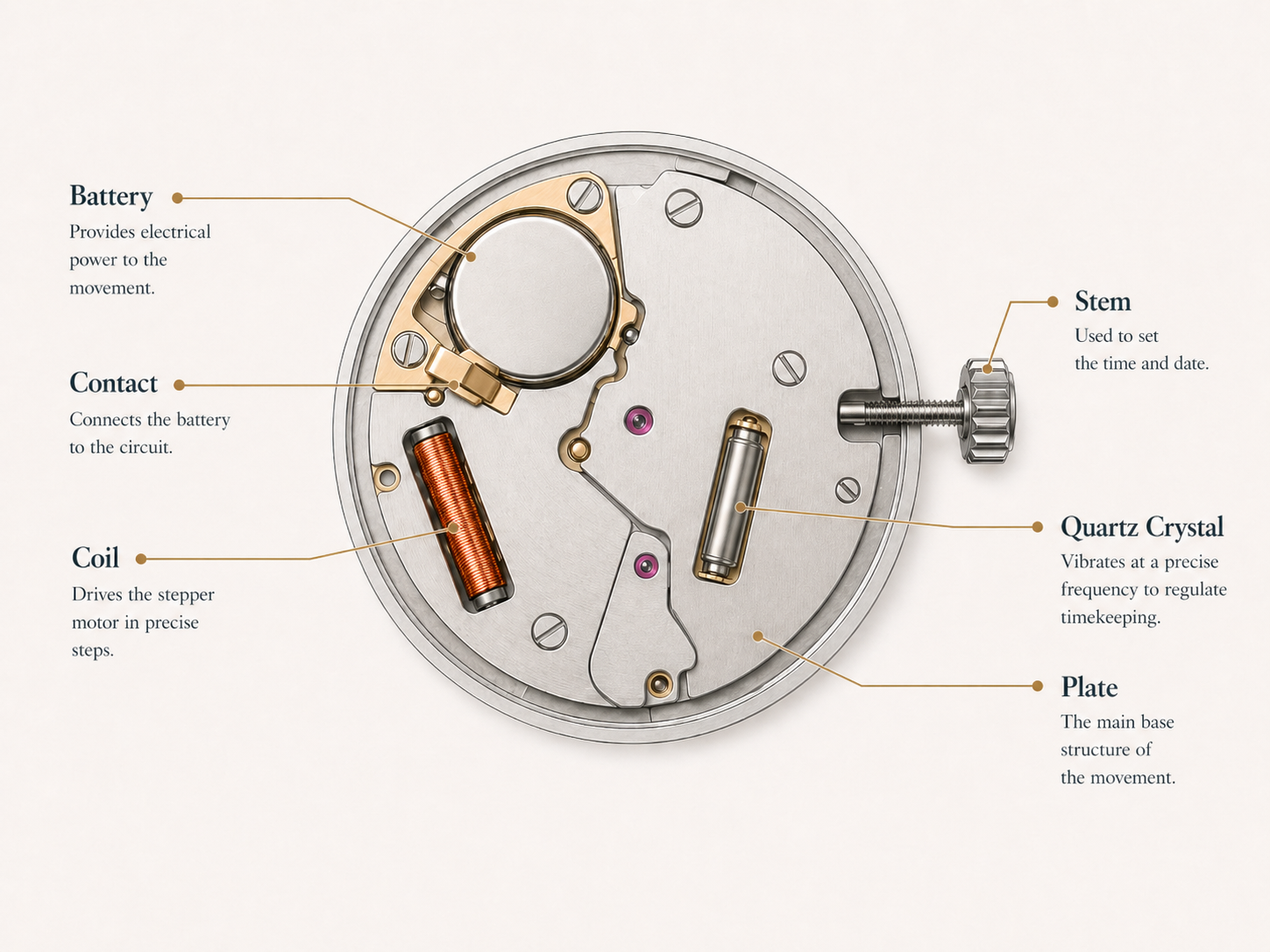
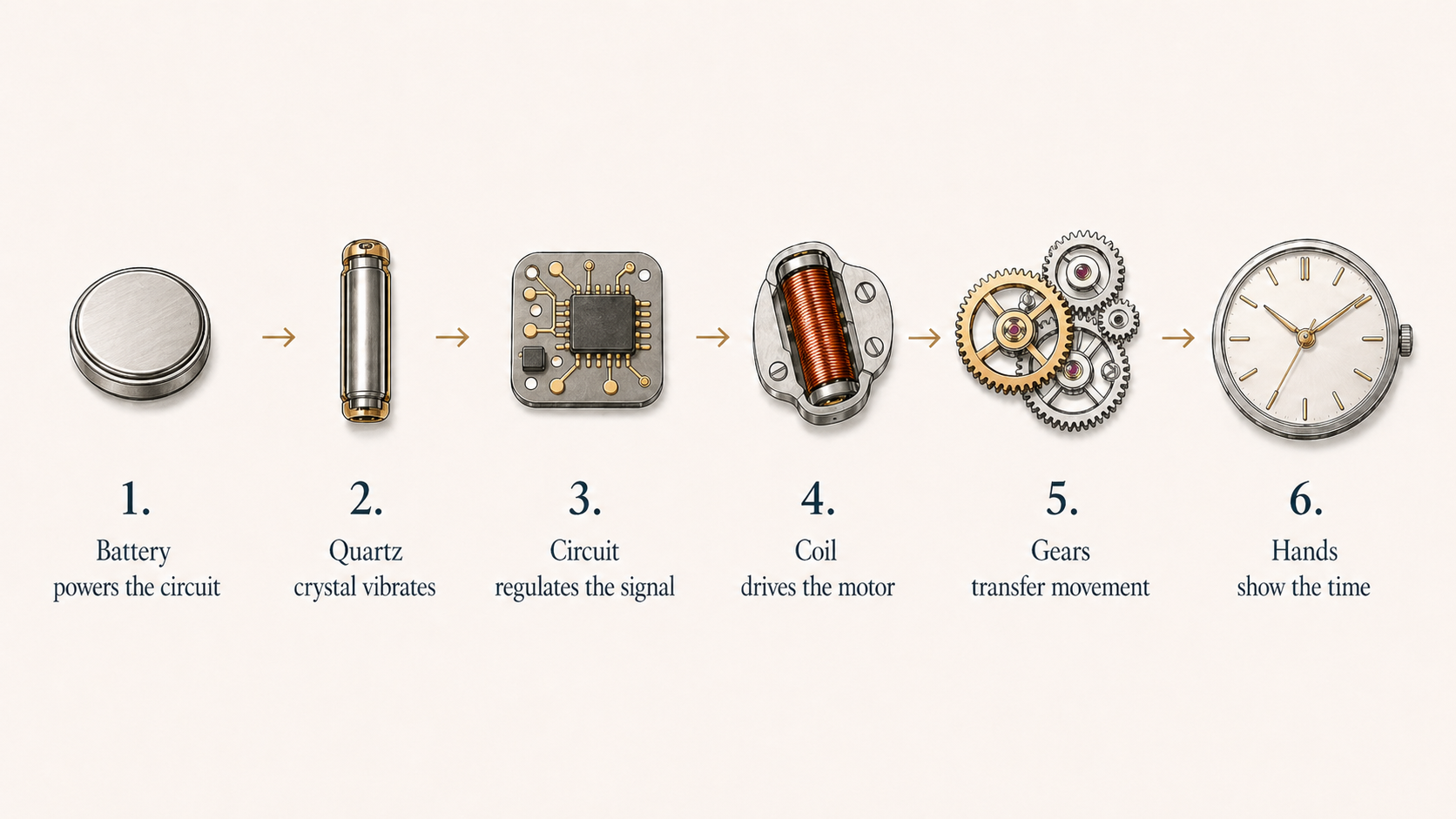
A quartz watch works by using a battery, an electronic circuit, a quartz crystal, a coil, a motor and a gear train.
The process is simple to understand, even if the engineering behind it is extremely precise.
The battery provides power
The battery is the source of energy in a quartz watch. It sends a small electrical current to the circuit inside the movement.
Because quartz movements use very little energy, a small watch battery can often power the watch for years.
The quartz crystal vibrates
Inside the movement is a tiny piece of quartz crystal. When electricity from the battery passes through it, the crystal vibrates at a highly regular frequency.
In many quartz watches, that frequency is 32,768 times per second.
That number may look oddly specific, because it is. It can be divided down electronically into one pulse per second, which makes it very useful for accurate timekeeping.
The circuit regulates the signal
The electronic circuit counts the vibrations from the quartz crystal and turns them into regular timing pulses.
In a typical analogue quartz watch, the circuit sends one pulse every second to the motor. This is what creates the familiar once-per-second tick of many quartz watches.
Some quartz movements are designed differently, including high-beat quartz movements with a smoother seconds hand, but the basic principle remains the same: the quartz crystal provides a stable timing reference.
The coil and motor move the gears
The pulse from the circuit passes through the coil and drives a small motor. This motor turns in tiny, controlled steps.
Those steps are transferred through a gear train, which moves the hour, minute and seconds hands around the dial.
The hands show the time
Finally, the movement of the gears is displayed through the hands on the front of the watch.
Why are quartz watches so accurate?
Quartz watches are known for their accuracy because the quartz crystal inside the movement vibrates at a very stable frequency.
In many quartz watches, that frequency is 32,768 times per second. The electronic circuit inside the movement counts those vibrations and divides them down into regular pulses. In a typical analogue quartz watch, this creates one pulse per second, which moves the seconds hand forward in clear, measured steps.
This is different from a mechanical watch, where timekeeping depends on the behaviour of springs, gears, the escapement and the balance wheel. Mechanical watches can be very well made, but they are more affected by position, temperature, movement and wear.
A quartz watch is not immune to variation, but it is generally much more consistent in everyday use. For most people, that means a quartz watch can be picked up, worn, and trusted without much thought.
That is one of the main reasons quartz watches became so popular. They made accurate timekeeping simple.
Quartz watches vs mechanical watches
Quartz and mechanical watches both tell the time, but they do it in very different ways.
A quartz watch uses a battery, a quartz crystal and an electronic circuit. It is designed to be accurate, reliable and low maintenance.
A mechanical watch uses a wound spring, gears, an escapement and a balance wheel. It is powered by stored mechanical energy rather than electricity. Manual mechanical watches are wound by hand, while automatic mechanical watches wind themselves through the movement of the wrist.
Neither type is simply better than the other. They offer different things.
A quartz watch is usually the more accurate and convenient choice. It does not need winding, it can usually be left unworn and picked up again without being reset, and its battery may last for several years.
A mechanical watch has a more traditional appeal. It offers the experience of wearing a small mechanical movement, powered by springs and gears rather than a battery.
If you want to understand that side in more detail, you can read our guide to how mechanical watches work.
For everyday ease, quartz watches are hard to argue with. For mechanical interest, automatic watches offer something more tactile and traditional.
Quartz, automatic and mechanical watches compared
Quartz, automatic and manual mechanical watches all tell the time, but the way they are powered is very different.
| Type of watch | How it is powered | Battery? | Winding needed? | Best suited to |
|---|---|---|---|---|
| Quartz | Powered by a battery and regulated by a quartz crystal | Yes | No | Someone who wants accuracy, convenience and low maintenance |
| Automatic mechanical | Powered by a mainspring, wound by wrist movement through a rotor | No | Usually winds itself while worn, but may need winding if left unworn | Someone who wants a traditional mechanical watch with everyday convenience |
| Manual mechanical | Powered by a mainspring, wound by turning the crown by hand | No | Yes, it needs regular hand-winding | Someone who enjoys the ritual and simplicity of a hand-wound movement |
For most people who want a watch they can simply pick up and wear, quartz is the easiest choice. For those who enjoy the feel and tradition of a mechanical movement, automatic watches are a good place to start.
Why do people choose quartz watches?
People choose quartz watches because they are practical.
They keep accurate time. They do not need winding. They do not stop after a day or two in a drawer. They are usually slimmer, easier to live with and more affordable to maintain than many mechanical watches.
That does not make them uninteresting. A good quartz watch can still have strong design, a well-finished case, a considered dial and the same sense of presence on the wrist as any other watch.
The movement is simply doing a different job. It is there to keep accurate time with as little fuss as possible.
For many buyers, that is exactly the appeal. A quartz watch is the watch you can pick up in the morning, put on, and trust to be right.
How long does a quartz watch battery last?
Battery life depends on the watch, the movement and how it is used, but many quartz watch batteries last for several years.
Some features use more power than others. For example, chronographs, alarms, backlights and additional functions may reduce battery life compared with a simple three-hand quartz watch.
When the battery starts to run low, some quartz watches may show signs such as the seconds hand jumping in larger intervals. Others may simply stop.
In most cases, replacing the battery is straightforward. It is usually best to have it done properly, especially if the watch has water resistance, as the caseback seal may need to be checked or replaced.
Solar quartz watches work slightly differently. They still use a rechargeable battery or cell, but it is charged by exposure to light rather than replaced at regular intervals.
How to look after a quartz watch
Quartz watches are low maintenance, but a little care will help keep them working properly.
Replace the battery when needed
If a quartz watch stops, the battery is usually the first thing to check.
It is best not to leave an old battery inside the watch for too long after it has run out. In some cases, old batteries can leak and damage the movement.
Be careful with water
A watch’s water resistance depends on its rating, crown, seals and case construction. Always check the water resistance of the specific watch before wearing it near water.
After a battery change, it is especially important that the caseback is closed properly and the seal is seated correctly.
Avoid strong impacts
Quartz watches are generally robust, but they are still small precision objects. Strong knocks can damage the hands, crown, crystal or internal movement.
Keep it clean
A soft cloth is usually enough for everyday cleaning. If the watch has been worn regularly, it is worth gently cleaning around the caseback, crown and bracelet or strap to remove dust and dirt.
Store it sensibly
If you are not wearing the watch for a while, keep it somewhere dry and away from strong heat, moisture or magnets. A drawer, watch box or pouch is usually fine.
Frequently asked questions about quartz watches
What is a quartz watch?
A quartz watch is a watch powered by a battery and regulated by a quartz crystal. The crystal vibrates at a stable frequency, helping the watch keep accurate time.
Do quartz watches need batteries?
Yes. All quartz watches need a battery. Some are solar-powered, but they still use a rechargeable battery or cell inside the watch.
How does a quartz watch work?
A quartz watch uses a battery to power an electronic circuit. The circuit sends electricity through a quartz crystal, which vibrates at a stable frequency. The circuit uses those vibrations to send regular pulses to a motor, which moves the gears and hands.
Why are quartz watches accurate?
Quartz watches are accurate because the quartz crystal vibrates at a very stable frequency. The circuit inside the watch uses that frequency as a timing reference.
How long does a quartz watch battery last?
Many quartz watch batteries last for several years, although this depends on the movement and the features of the watch.
Are quartz watches better than mechanical watches?
Not necessarily. Quartz watches are usually more accurate and easier to maintain. Mechanical watches appeal for their traditional movement, engineering and more hands-on character.
Do quartz watches tick?
Many analogue quartz watches tick once per second. This is because the circuit often sends one pulse per second to the motor. Some quartz watches are designed differently and may have a smoother seconds hand.
Are quartz watches worth buying?
Yes. Quartz watches are accurate, practical and easy to own. They are a strong choice for anyone who wants reliable everyday timekeeping without regular winding.
Can a quartz watch last for years?
Yes. A good quartz watch can last for many years with sensible care and battery replacement when needed.
What happens when a quartz watch battery dies?
When the battery dies, the watch will usually stop. In most cases, the battery can be replaced and the watch will start running again.
Final thoughts
Quartz watches are sometimes talked about as if they are simply the practical alternative to mechanical watches. That is true, but it undersells them a little.
A good quartz watch is accurate, reliable and easy to live with. It does not need winding. It does not need to be worn every day to keep running. It simply uses a battery, quartz crystal and electronic movement to keep consistent time with very little attention.
For some people, the charm of a mechanical watch will always be the main attraction. For others, quartz makes more sense. It offers dependable everyday timekeeping in a watch that can still be well designed, nicely finished and enjoyable to wear.
If you want a watch that is simple, accurate and ready when you are, a quartz watch is a very sensible place to start.